





- Find the best broker for your trading needs
- Compare spreads, fees, and platforms
- Read in-depth reviews and analysis

Page Navigation


Select a different country or region to view content tailored to your location.

FxScouts helps traders across the globe by meticulously testing and reviewing online brokers and providing Forex education and market analysis. Our partners compensate us through paid advertising. While partners may pay to provide offers or be featured, they cannot pay to alter our recommendations, advice, ratings, or any other content. Our content and research teams do not participate in any advertising planning nor are they permitted access to advertising campaign data. For more detailed information click this link.

Alison Heyerdahl is the Head of Content at FxScouts and a Chartered Market Technician (CMT), as well as a trader and financial writer with extensive experience in Forex trading, broker analysis, and market research. She has reviewed 100+ brokers, publishes weekly YouTube trading videos, and co-hosts the “Let’s Talk Forex” podcast.

Alison Heyerdahl is the Head of Content at FxScouts and a Chartered Market Technician (CMT), as well as a trader and financial writer with extensive experience in Forex trading, broker analysis, and market research. She has reviewed 100+ brokers, publishes weekly YouTube trading videos, and co-hosts the “Let’s Talk Forex” podcast.
Chris Cammack is the Partner Manager and a financial writer at FxScouts. Chris builds and maintains our relationships with our partners to provide our users with the best Forex trading experience.
Some traders prefer ECN (Electronic Communication Network) brokers because they offer direct market access to a network of liquidity providers, removing any conflict of interest. But the main advantage is reduced trading costs, with most ECN brokers charging a flat commission on top of raw spreads. The ECN brokers below have been selected for their transparency, reputation, and low trading costs but are otherwise quite different. Whether you are looking for an ECN broker with high leverage, excellent education, commission-free accounts, or a specific trading platform, you are sure to find it here.
Trusted. Transparent. Tested.
For over a decade, we’ve set the standard in forex broker reviews—collecting thousands of data points yearly to deliver unbiased, expert-backed insights.
Skip the trial and error! Below, you’ll find the best forex brokers for Nigerian traders for 2026—thoroughly tested, verified, and ranked, so you can trade with confidence.

You can either use the arrow button or swipe on mobile
Broker | Official Site | EUR/USD - Standard Account This is the spread on EUR/USD using the account with the smallest deposit requirements. | Trading Cost - Standard Account Total trading cost at the time of last update, for 1 lot of EUR/USD using the account with the lowest minimum deposit. Includes spread and commission. | EUR/USD - Raw Spread EURUSD spread on account with best pricing available for pro traders. | Trading Commission | FSCA Regulated | Platforms | Trading Desk | Compare | |||||
|---|---|---|---|---|---|---|---|---|---|---|---|---|---|---|
 | USD 0 | 400:1 | 1.00 pips | USD 10 | 0.10 pips | 6 USD / lot | No | 1597 | 90 | MT4, MT5, cTrader, TradingView, Pepperstone Platform | NDD | |||
 | USD 200 | 500:1 | 0.10 pips | USD 8 | 0.02 pips | 7 USD / lot - Raw Spread Account | No | 1744 | 64 | MT4, MT5, cTrader, TradingView | ECN/DMA | |||
 | AUD 100 | 500:1 | 0.00 pips | USD 6 | 0 pips | 6 USD / lot - RAW Accounts | Yes | 10162 | 70 | MT4, MT5, cTrader, TradingView | ECN/DMA | |||
 | USD 0 | 1000:1 | 1.00 pips | USD 10 | 0.00 pips | 9 USD / lot - PRO account | No | 1318 | 83 | MT4, MT5, TradingView | ECN/DMA |





Select another broker to another broker to compare features, fees, and platforms side by side.
Find Your Ideal Forex Broker
Select another broker to another broker to compare features, fees, and platforms side by side.
0 pips
CMA, BaFin, ASIC, FCA, CySEC
USD 0
Pepperstone Platform, TradingView, cTrader, MT5, MT4
400:1
Pepperstone’s Razor account offers true ECN-like conditions with spreads from 0.0 pips on majors and a $3.50 commission per lot per side.
Direct fibre connectivity to liquidity providers ensures sub-30ms execution latency—ideal for scalping and HFT strategies.
Supports MT4, MT5, and cTrader, all integrated with raw pricing feeds and low-latency execution for algorithmic traders.
FCA, ASIC, and CySEC licenses provide top-tier fund protection and negative balance guarantees—a critical factor for Nigerian clients using offshore accounts.
Nigerian traders must use USD-based accounts and third-party funding methods like Skrill or crypto.
Unlike some competitors, Pepperstone does not offer signup or deposit incentives, focusing instead on raw trading conditions.
Pepperstone | Best for: Nigerian traders seeking lightning-fast ECN execution with raw spreads and strong regulatory backing

FxScouts
 YouTube
Select another broker to another broker to compare features, fees, and platforms side by side.
0.1 pips
FSA-Seychelles, SCB, ASIC, CySEC
USD 200
TradingView, cTrader, MT5, MT4
500:1
IC Markets connects to over 25 tier-1 liquidity providers, offering raw spreads from 0.0 pips and $3 commission per lot per side—ideal for large-volume traders.
Servers hosted in NY4 and LD5 data centres reduce latency and slippage, which is critical for scalping and news trading.
All platforms use raw price feeds, with deep integration for algorithmic and API-based strategies.
IC Markets imposes no limitations on scalping, latency arbitrage, or automated systems, enabling advanced strategies.
Clients in Nigeria must use international gateways like Neteller, Skrill, or crypto wallets.
Content and webinars are globally focused, with limited local market guidance or support.
IC Markets | Best for: Professional Nigerian traders needing institutional-grade spreads, deep liquidity, and excellent automation compatibility
FxScouts
YouTube
Select another broker to another broker to compare features, fees, and platforms side by side.
0.0 pips
FSCA, ASIC, CySEC
AUD 100
TradingView, cTrader, MT5, MT4
500:1
Established in 2005, FP Markets offers a great range of third-party platforms, including MT4, MT5, cTrader, and TradingView, and an in-house trading platform. With a minimum deposit of 100 USD, tight spreads starting from 0.0 pips on the Raw account in exchange for a commission of only 6 USD per lot traded, it is particularly appealing for scalpers and day traders.
FP Markets also has an impressive range of trading tools, including free Autochartist, VPS services, and the Trader’s Toolbox for an enhanced trading experience, and many different copy trading services. Its education caters to both beginners and more experienced traders, and its market analysis is frequently updated by an in-house research team.
Spreads start from 0.0 pips and commissions from $3 per lot per side, delivering one of the lowest-cost ECN setups in the market.
Latency under 40ms to NY servers enhances trade accuracy during volatile periods, ideal for news traders.
Supports NGN funding through trusted e-wallets and crypto channels, enhancing convenience for local users.
Includes Autochartist, VPS access, and advanced order types directly within the trading terminal.
New traders may find the pure ECN interface too complex without beginner-friendly guides or visual dashboards.
Training materials and webinars don’t yet address Nigerian-specific challenges like FX volatility or banking regulation.
FP Markets | Best for: Nigerian scalpers and EAs users seeking an ultra-low-cost ECN environment with customisable liquidity
FxScouts
YouTube
Select another broker to another broker to compare features, fees, and platforms side by side.
0.0 pips
FMA, FSA-St-Vincent, DFSA, ASIC, FCA
USD 0
TradingView, MT5, MT4
1000:1
Offers 0.0 pip spreads and $3.50 commission per side, backed by liquidity from top-tier banks—similar to true ECN setups.
Free access to professional trader analytics helps identify and improve trading weaknesses, especially helpful for self-coaching.
Receive real-time market scanning and trade ideas, which are rarely included for free in ECN accounts.
Provides strong fund safety and transparency, essential for traders in Nigeria using offshore brokers.
Clients must rely on global channels like Skrill or crypto for funding.
Webinars and tutorials are less regularly updated than competitors like Pepperstone or Exness.

Axi | Best for: Nigerian traders looking for raw spreads, deep liquidity, and free premium tools like Autochartist and PsyQuation
FxScouts
YouTube
Select another broker to another broker to compare features, fees, and platforms side by side.


ECN brokers use high-speed networks to find the best pricing available and execute trade orders as quickly as possible. Where an ECN broker gets its market pricing and how fast it executes trades should always be considered alongside other more standard broker metrics.
When comparing ECN brokers, always consider:
Trading cost: Traders seek out ECN brokers because of their low trading costs. Trading costs on ECN accounts are a combination of the spread and a commission. Trading costs for one lot of EUR/USD at ECN brokers will range from 6 USD to 18 USD, depending on the broker’s trading conditions.
Execution quality: A combined metric used to discuss execution speed, slippage and rejection rate, execution quality describes the connection between the broker and the market and will directly impact the level of control a trader has over their positions. A high-grade ECN broker will have fast execution speeds, which leads to less slippage in pricing between when the order is executed and when it is opened, and less order rejection due to unavailable counterparties. Better execution quality will produce fewer unintentional losses.
Execution venues: ECN brokers are never counterparty to client trades. Instead, they use their network to place trades with third parties. These third parties are called execution venues. The more execution venues an ECN broker has, the more competition there will be for its client’s trades, leading to lower spreads and lower overall trading costs for traders.
Tradable Assets: A good ECN broker will offer clients a larger number of FX pairs and other CFD assets to trade. Having a limited set of trading assets can negatively affect traders, as they may miss out on opportunities.
Regulation: Regulators monitor the activities of the broker and the trading desk. Unregulated ECN brokers are risky as there’s no way to verify their ECN status without depositing funds and trading. Brokers regulated by the FCA (UK), ASIC (Australia), or MAS (Singapore) are known for strong enforcement and ensure their member brokers follow strict protocols to protect clients and their trades.
Trading tools: Leading ECN brokers offer features like free VPS services for high-quality execution around the clock. Other tools may include custom indicator packages, automated trading support, and in-platform market analysis tools such as Trading Central or Autochartist.
An ECN broker is a Forex broker that uses an electronic communication network (ECN) to connect traders with liquidity providers. Unlike Market Maker brokers, ECN brokers do not take the opposite side of client trades.
ECN stands for Electronic Communication Network. The broker sits at the center of this network, connecting clients with liquidity providers like banks, hedge funds, and other brokers.
When a trader places an order, the ECN broker gathers prices from its network and presents the best available spread to meet the trade volume. Because these liquidity providers compete for trades, ECN brokers typically offer ultra-tight spreads, often approaching 0 pips.
ECN brokers do not profit from the spread. Instead, they charge a commission for matching your trade with a counterparty. In contrast, Market Makers widen spreads to include their fees.
Since ECN brokers act only as intermediaries, they don’t benefit from client losses. In fact, successful traders generate more commissions over time, which aligns ECN brokers’ interests with those of their clients.
Many traders prefer ECN brokers because there’s no conflict of interest. Market Maker brokers often trade against their clients, profiting when they lose. ECN brokers, by contrast, earn more when their clients trade more—and profit more.

ECN brokers face a higher risk of slippage and requotes, especially during periods of high volatility or low liquidity. Because they rely on external liquidity providers to match trades, there may be delays in execution. This can lead to price movements beyond stop-loss levels, resulting in unexpected losses.
ECN brokers generally require a higher minimum deposit. Running an ECN brokerage is costly, and these expenses are passed on to traders through deposit requirements and commissions.


With an ECN broker, the counterparty to your trade will be a liquidity provider from the broker’s network. With a market maker broker, the broker themselves will be the counterparty to your trade. Market Makers create an artificial market for their clients – hence the name.
Market Makers are also known as dealing desk brokers, as all trades will be filled at the rates set by the broker’s internal dealing desk. This business model, which means a market maker will always profit from their clients’ losses, generates an inherent conflict of interest which many traders are cautious of.
Currently, most well-regulated market makers are well regarded in the industry, despite the conflict of interest, and they go to great lengths to ensure their clients are not being unfairly treated.
But, Market Maker brokers are not a common choice for experienced Forex traders. Traders are limited to trading with one counter-party who is always trading against you and never on the open market with dynamic spreads.
However, if you do want instant execution of your trades and you don’t want to pay a commission, a trusted market maker is a good idea.
There are a few ways to check: ECN brokers will describe their execution model in their legal documents, ECN brokers will always have variable spreads, ECN brokers will not have any trading restrictions (trade size, stop-loss limits, scalping or hedging bans), and traders with an ECN broker will experience both negative and positive slippage.
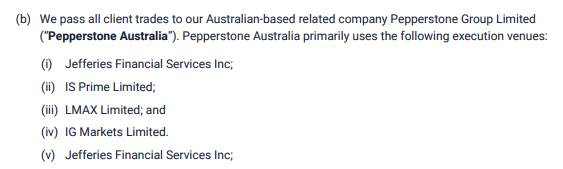
All regulated brokers are required by law to publish a Client Agreement and Order Execution Policy stipulating their execution methods. Some ECN brokers will also act as Market Maker in certain circumstances, so this is not an always foolproof method of determining a broker type. See below for an extract from Pepperstone’s execution policy showing that they are an ECN broker.
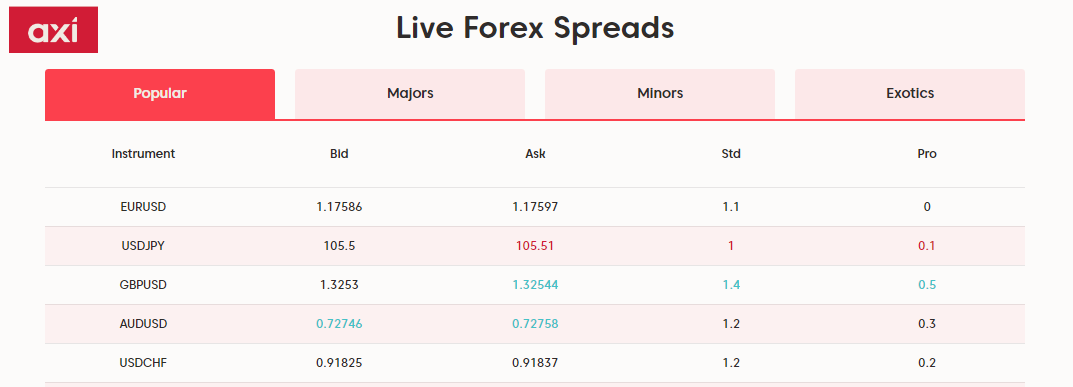
ECN’s offer tight spreads and charge a commission per trade, and the spreads will also be variable. Fixed spreads are only offered by Market Makers, as they are not taken from a live and dynamic market. Below you can see that Axi publishes its live spreads on its website, these are variable and are taken from their network of liquidity providers.
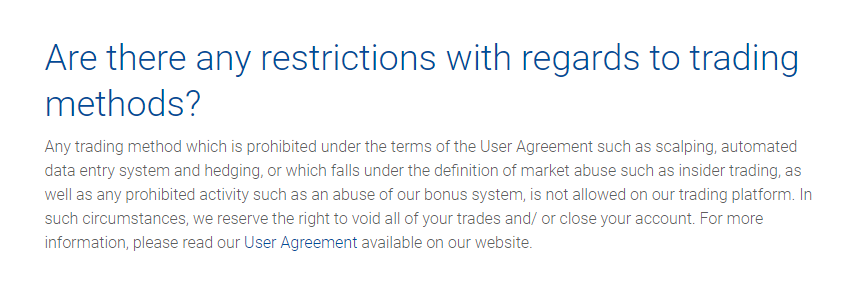
ECN brokers will never restrict your trading methods or trade size. This means that all automated trading, scalping, hedging and large order sizes (anything of 5 lots or over) will all be allowed. If a broker restricts any of these then it is not an ECN broker.
A good example of a broker with these restrictions is Plus500, a well-known market maker:
Slippage is the difference between the execution price and the order price at the time the order is submitted for execution. Slippage is a normal aspect of trading with ECN brokers, particularly for orders of a larger size and during times of thin liquidity and/or volatile market conditions.
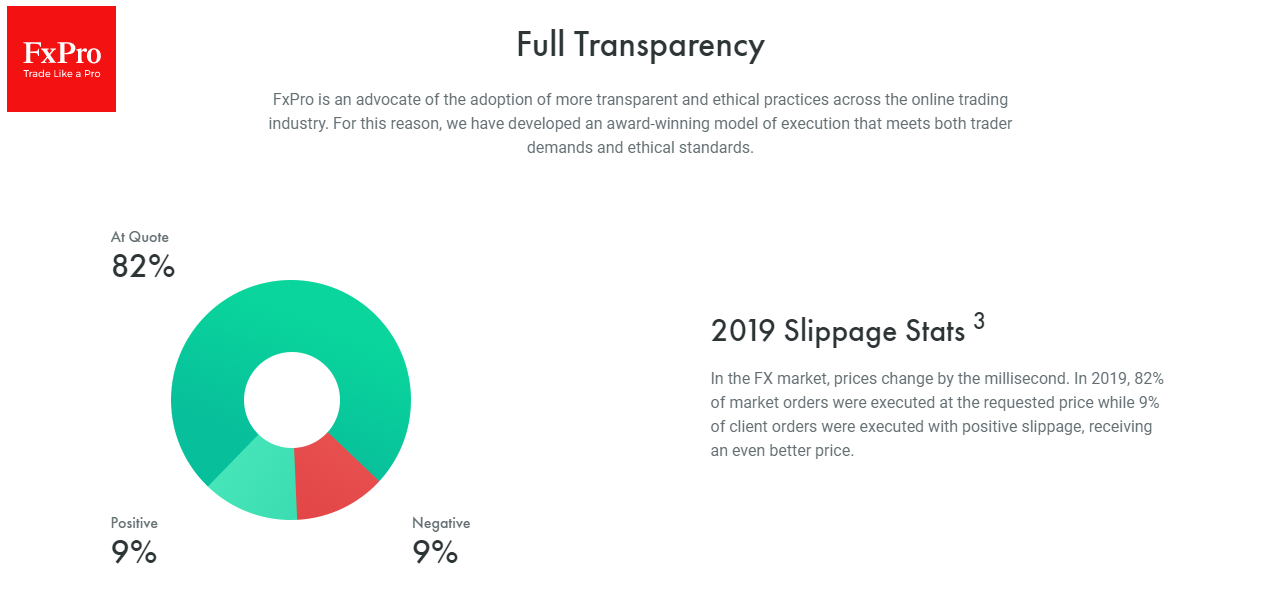
Slippage can both positively and negatively impact your trading position. If you find that you are only experiencing negative slippage, then your broker is not using an ECN execution method. Another well known ECN broker is FxPro, which is dedicated to full transparency and always publishes its slippage statistics, see below for its 2019 figures:
So, while ECN brokers do not have the inherent conflict of interest present with market makers, commission will always be charged on your trades. ECN accounts will also require a higher minimum deposit – putting them out of reach for many beginner traders.
Are ECN brokers objectively better than market maker? This is not necessarily the case. All brokers we work with are trustworthy and well-regulated and broker choice is always down to personal preference. Whether you go with an ECN broker or a market maker, if you choose one from our list of the best in South Africa you will be in good hands.


Find answers to the most common questions about ECN brokers.
ECN Accounts will have tighter spreads than a Standard Account, but you will have to pay a commission per trade. Standard Accounts will not have any commission, but spreads will be wider.
ECN Brokers make money by charging traders a commission per trade. Because they pass pricing on directly from their liquidity providers, they do not charge a fee in the spread.
ECN/STP brokers are better because they will have less slippage and a faster execution speed than a pure ECN broker.
STP (Straight Through Processing) is the method of the transaction – with STP your order is sent directly to the counterparty through the Financial Information Exchange (FIX) protocol. The FIX protocol decreases trade execution time, reduces slippage, and ensures that traders get the best available pricing.
The STP protocol can be used by market-maker brokers as well as ECN brokers, and some brokers use a hybrid formula, where they will sometimes be the counterparty, and other times use an external liquidity provider. While this does lead to less slippage, it does mean that some trades will have a conflict of interest.
In most cases choosing a hybrid broker is the best way to go, as they will give you the most options.
Explore more resources that fellow traders find helpful! Check out these other guides to enhance your forex trading knowledge and skills. Whether you’re searching for the best brokers, educational material, or something more specific, we’ve got you covered.

Discover the top Forex brokers in Nigeria. Compare top platforms, fees and features to make an informed trading choice.

Compare the best Forex trading platforms for 2026, including MT4, MT5, cTrader, and TradingView. Find the right tools to enhance your trading experience.
What is Forex trading and how does it work? An easy-to-read guide including how to trade, and how to choose a reliable broker.
60-90% of retail traders lose money trading Forex and CFDs. You should consider whether you understand how CFDs and leveraged trading work and if you can afford the high risk of losing your money. We may receive compensation when you click on links to products we review. Please read our advertising disclosure. By using this website, you agree to our Terms of Service.
Partner Manager and Financial Writer
Head of Content
Financial Writer




Welcome to the FxScouts community! We’re thrilled to have you on board. You’ve successfully signed up for our forex newsletter, where you’ll receive expert insights, market analysis, and the latest news straight to your inbox.
Get ready to stay ahead of the curve with our regular updates designed to help you make informed trading decisions.
Happy trading!
The FxScouts Team